Why Your Website Isn’t Converting—and How Custom Development Solves the Real Problem
For many businesses, a website that “looks good” still fails to produce meaningful results. Traffic may be steady, but leads are inconsistent. Engagement feels shallow. Conversion rates stall without a clear explanation.
This disconnect often leads to surface-level fixes—changing headlines, swapping images, or tweaking calls-to-action. While those adjustments can help, they rarely address the deeper issue: the website itself was not built to support how users think, evaluate, and decide.
Custom development, when approached strategically, solves problems that templated or pieced-together solutions often leave behind.
The Hidden Reasons Websites Don’t Convert
Poor Technical Performance Creates Immediate Friction
Users form impressions quickly. If your site loads slowly, behaves inconsistently across devices, or feels unstable, trust erodes before your message is even processed.
Google has reinforced this repeatedly. As noted in their research on page experience:
“As page load time goes from one second to three seconds, the probability of bounce increases 32%.”
— Google/SOASTA Research
Performance is not just a technical metric—it directly impacts whether users stay long enough to consider your offering.
Custom development allows performance to be engineered intentionally. Instead of working around the limitations of a theme or plugin stack, the site is built to prioritize speed, stability, and scalability from the start.
Unclear Value Propositions Leave Visitors Guessing
Even technically sound websites can fail if they do not communicate clearly.
Many businesses struggle to answer a simple question within the first few seconds of a visit:
- What do you do?
- Who is it for?
- Why does it matter?
When messaging is vague, overly broad, or internally focused, visitors are forced to interpret meaning on their own. Most won’t.
This is often not a copywriting issue alone—it’s structural. Templates tend to impose layouts that don’t align with how your audience evaluates decisions.
Custom development creates space for clarity. It allows content hierarchy, layout, and messaging to work together so that value is communicated quickly and confidently.
Weak Calls-to-Action Create Hesitation
A common misconception is that adding more calls-to-action will increase conversions. In reality, unclear or poorly placed CTAs often do the opposite.
Visitors hesitate when:
- The next step isn’t obvious
- The action feels too large or premature
- The context doesn’t support the decision
Custom-built websites allow CTAs to be integrated naturally into the user journey. Instead of forcing action, they guide users toward it—based on intent, timing, and relevance.
Why Custom Development Addresses the Root Problem
Custom development is not about design preference or visual uniqueness. It’s about alignment—between your business goals, your audience’s behavior, and the technology supporting both.
It Aligns Structure with Decision-Making
Every business has a slightly different sales process, even online. Some require education. Others require comparison. Some depend on trust signals over time.
A templated site assumes a generic path. A custom site reflects your actual one.
This means:
- Content is structured around how users evaluate options
- Pages support different stages of the decision process
- Navigation reinforces clarity instead of adding complexity
It Reduces Technical Debt
Many websites accumulate layers of plugins, patches, and workarounds over time. This creates fragility—small changes cause unintended issues.
Custom development reduces this dependency. The result is a system that is easier to maintain, faster to adapt, and less prone to hidden breakdowns.
It Supports Long-Term SEO and AI Visibility
Search engines—and increasingly AI systems—prioritize clarity, structure, and performance.
A custom-built site makes it easier to:
- Organize content logically
- Implement clean, semantic code
- Scale content strategy over time
For businesses thinking beyond short-term traffic gains, this foundation matters. Resources like Jemully’s approach to SEO engineered for AI visibility emphasize how technical structure and content strategy must work together to remain discoverable.
A Common Misunderstanding
Some assume that custom development is only necessary for large or complex organizations.
In reality, the need is less about size and more about misalignment.
If your website:
- Doesn’t reflect how your business actually operates
- Forces your messaging into a rigid structure
- Requires constant workarounds to function properly
…then the issue is not scale—it’s fit.
Why This Matters for Businesses
A non-converting website is not just a marketing problem. It affects how your business is perceived, how opportunities are captured, and how efficiently growth can occur.
When the foundation is misaligned, every downstream effort—SEO, paid traffic, content—becomes less effective.
Custom development doesn’t guarantee conversions on its own. But it removes the structural barriers that prevent them.
Keeping It In Perspective
If your website isn’t converting, the instinct is often to adjust what’s visible—headlines, colors, or buttons. Sometimes those changes help. Often, they don’t go far enough.
Stepping back to evaluate how the site is built—technically and structurally—can reveal clearer answers.
When a website is designed around how people actually think and decide, performance improves in a way that feels natural, not forced.
That shift—from patching symptoms to solving underlying problems—is where meaningful progress tends to begin.

About the Author
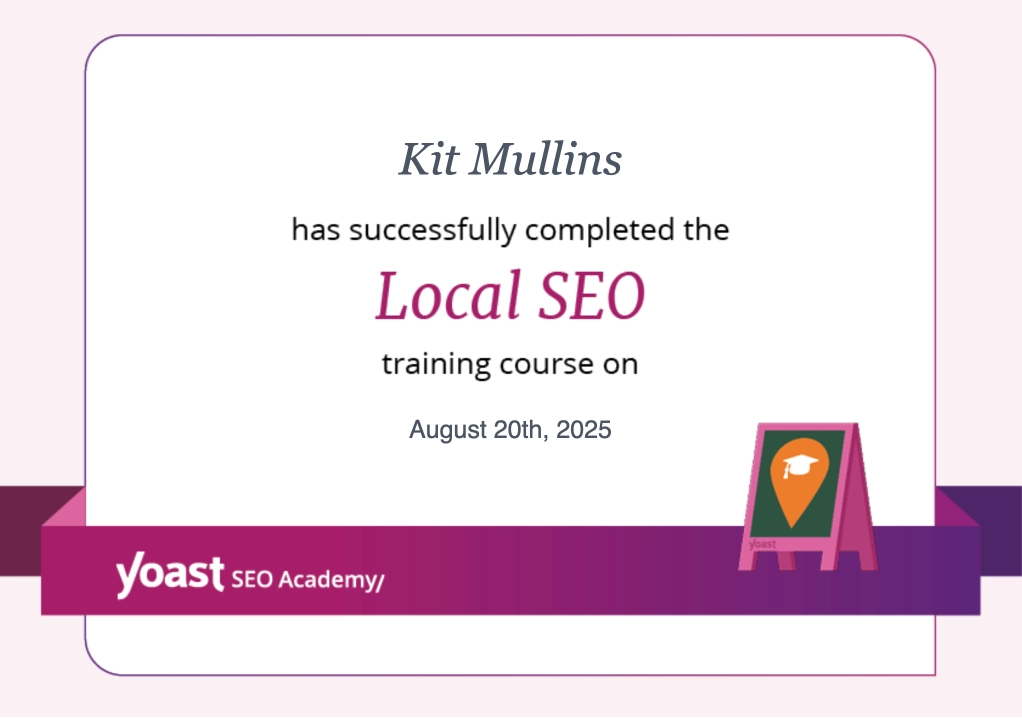
Kit Mullins, co-owner of Jemully Media, LLC, has been a leader in digital marketing for more than twenty years. A writer, designer, and developer, Kit enjoys travel, photography, and Bible study. With six kids and fifteen grandkids, she has no choice but to find ways to be creative.